Grief, play, and letting something move – World Art Day 2026
By Ben Robin Lucent
“I have a basketball in the boot. Would you be up for stopping to shoot some hoops?” I said this yesterday, as we got back to the car. We’ve both experienced two deaths, very close together, in the past few months. It was a good, if grey, January walk. We chewed over some logistics, a little bit of the feelings.
The idea had popped into my head earlier in the day, and I knew it sounded… unusual. She didn’t know what to make of it, but she played along.
When we arrived at the court, it turned out to be a hoop in a children’s playground. Two adults walking in with a basketball, past parents and kids. It was a bit awkward. We acknowledged that. We laughed. I said, “Ten minutes. Let’s just try ten minutes.”
We stayed for forty-five.
We shot badly. Then slightly better. We moved. Two kids joined in and we took turns. We laughed. At some point, my friend mentioned she’d played basketball in school (which was clear from her muscle memory). I hadn’t known that. I had too, but I was never any good, which was also very clear from my muscle memory.
That really wasn’t the point, though, and probably added to the fun. It didn’t feel like exercise. It didn’t feel like processing. It didn’t feel like coping or even a distraction. It felt like being there. Responding to what was happening next. The grief didn’t disappear, but it wasn’t the only thing. We left sweaty, smiling, surprised. Our minds couldn’t possibly have imagined how good it would feel.
That wasn’t the first time grief led me somewhere unexpected.
Years ago, when I was off sick from a corporate job I would eventually leave, I was sitting with a different kind of grief. It lived in my throat. A literal lump. A pain that didn’t move. The kind that can arrive with significant change: a shift in identity, the loss of a role, the ending of a way of being in the world.
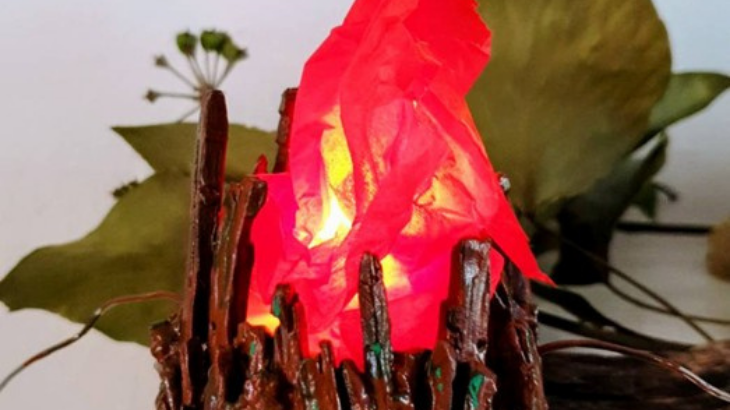
I knew that ignoring it wasn’t working. That it needed to be witnessed, felt. It occurred to me to sit with it while doing something creative. I got some clay. At that point, I wasn’t really sculpting. I hadn’t made anything like that with my hands in years. I started smushing it, enjoying the coolness of the clay warming and softening. Then rolling it out, noticing there was a pattern on the tool that made the clay look like wood. I followed that. I cut the clay into small pieces, realising they looked like sticks, and gradually realised I was making something that looked like a small campfire.
I painted it with acrylic markers. I put a candle inside it at first, but after it rather quickly threatened to become an actual fire, I made flames from red paper on a little battery-operated candle instead.
It felt like the fire was for the pain. An expression of it, or a place for it to burn through. It felt like some of it came out through the doing, into this surprisingly tender little object that hadn’t existed before. Every time I passed by and noticed it, I felt a little lift. Not because it was beautiful, but because I had made something.
It was an emblem of care.
It gave a shape to something words couldn’t have expressed and externalised both the pain and my loving gesture towards it.
What shocked me most was that I had no idea, when I sat down, that this was what would happen. I didn’t plan it, I couldn’t have thought it up—if I had, I might have been intimidated. I just put one hand-movement in front of the next, followed the rhythm of it, and something emerged. Something was expressed. The thing happened because I sat down with the intention of keeping company with that awful grief-lump in my throat and started smushing clay.
There were other times in that period when I tried to do something creative or playful and nothing “useful” came of it. That’s not the promise here. This isn’t about guaranteed outcomes. It’s about accompaniment. Allowing. Taking the stance of kindness and permission to mess, to try, to follow the feeling and the thread of movement and inspiration, for the sake of the process, the energy that moves in the process.
I have experienced that sometimes doing something open-ended while you’re in pain allows you to feel what you’re feeling without being engulfed by it. When you’re engaged in something un-directed, the body can take the lead. It often knows the symbol it wants. It knows how it wants to express itself. You only need to set the scene.
Standing in the hospice a few weeks ago, I heard myself saying this and it touched me: Everything and everyone is constantly arriving and leaving. We keep on leaving, and we keep on arriving.
I was thinking of the approximately 360,000 babies that were born that day and the approx. 165,000 people who died. Of the communities of birth and death that arose that day, all over the globe, of which we were a part.
The feelings involved in grief are so varied, and they are as much evidence of love as they are of loss. Not wanting to feel them, feeling that they are too much, not enough, wrong, or being unable to process them on any predictable timeline, is a shared journey for all however-many-billion of us there are on this planet, all the time.
Sometimes the feelings register as pain and act like a signal, pointing to a need—a part of us that is no longer being met, or that needs acknowledgement and care—much like the insistent sting of a cut or injury that needs tending. Sometimes they pull us into stories in our minds. Our bodies respond to replayed memories as if they are happening again, right now, and can become afraid or anxious in response.
Sometimes, when the energy of the feeling has nowhere to go, it becomes stagnant or starts to loop, and it intensifies, spilling out in unpredictable ways.
Playfulness can be good medicine for these kinds of wounds, an antidote to heaviness, stuckness, loneliness. In play, we offer ourselves company. With our hands or bodies engaged, we’re drawn into the next small move: the micro-decision, the feel of the thing we’re holding, the arc of a ball. Our bodies respond well to this kind of presence. They like it when the mind is here with them, absorbed in something familiar and pleasant.
As children, many of us were naturally drawn to particular kinds of play. Left to choose freely, with less self-consciousness, we went to the trees, our teddies or toy cars, colouring pencils, balls, a mixing bowl of grasses and berries. We knew, instinctively, what we enjoyed, what helped us feel free and good. Those things might still be doorways.
The things that used to feel good can still feel good. That information isn’t always available to us now, and that’s okay—don’t force it. It’s also very possible that as you’re reading this you realise something completely new has been calling to you.
Sometimes the seed the question plants will sprout in a few days. A friend says something. An advert catches your eye. A song jogs a memory. A walk loosens an image.
You might already have paths to playful activity in your life, but if you don’t, start small. Smaller. Smallest. If you feel called to experiment, a good place to begin is with a time-bounded (literally, set a short timer), goal-less gesture to yourself, something that doesn’t need to justify itself. If it feels like too much, or you find yourself researching how to kit yourself out for a whole new hobby, pause. Pare it back to what you could do in a few minutes. Buy one small pack of gel pens. Spend ten minutes looking in that box you suddenly remembered you have.
Another small adventure in play might be a trip to a charity shop, a craft store, a toy shop, a fabric shop. A magazine about something you loved when you were young. The library. Movement. Animals. A ball in the boot of the car. Whatever it is, start tiny. Let it seed itself, not become another chore.
Grief needs expression. Not always explanation, or resolution. Just expression.
It might be through pouring paint and sloshing it around. It might be movement and laughter. It might be making something that only makes sense to you. It might be the small win of feeling like you’ve achieved something as you complete the edges of a jigsaw puzzle of the dolphins you loved as a child. The form doesn’t matter.
There is no way to play wrong just as there is no way to grieve wrong. Only let it move.