Celebrating Women in End of Life Care this International Women’s Day
International Women’s Day is Sunday, 8th March this year, providing an opportunity to reflect on the support that women provide within healthcare, more specifically, end-of-life care.
We asked our Director of Healthcare, Siobhán Murphy, to reflect on this. Given her current role as Healthcare Director, leading our national programmes focused on improving quality end-of-life care, and having previously worked as a registered nurse with over 30 years’ experience – 15 of those as a clinician in nursing and palliative care, and the remainder in other roles in Primary Care and disability services – Siobhán was able to reflect on her lived experience in the industry, as well as her current involvement in research and planning improving care at end of life across Ireland with IHF.
To find out more about International Womens Day, you can visit the IWD website.

International Women’s Day provides an opportunity to pause and reflect on the often-invisible work and support that women provide… Women, are the people who do the main caring for their young children, support ageing and ill parents and family members, and provide end-of-life care.
While acknowledging that both men and women provide healthcare support, the World Health Organization states that women make up approximately 67% to 70% of the global health and social care workforce. In Ireland, CSO figures state that 76.6 % of our healthcare workforce are women, with 90% of practicing nurses being women, and also suggesting that most Healthcare Assistants are female. This all suggests that there is a high proportion of caring responsibility placed on women including when end-of-life approaches.
It is estimated that women provide essential health services for around 5 billion people worldwide. The financial value of women’s input into health systems is estimated to be over US$3 trillion annually. Yet women’s contributions to health and the health labour market remain markedly undervalued. Women in health tend to be clustered into lower status, low paid, and often unpaid roles.
World Health Organization
While women in these roles often describe this care as meaningful, and a privilege, end-of-life care highlights pressure placed on women at this time. While other healthcare providers and specialists provide guidance and clinical support, much of the day-to-day care for people who wish to die at home is delivered by family members, in the main, women. They become caregiver, advocate, decision-maker and often become the key person in co-ordinating care for the individual while having to navigate complex healthcare systems and communicate with professionals and clinicians. They are also the go-to person for all other family members and friends. After a family member dies, many caregivers will move straight from significant caregiving responsibilities into grief and bereavement, with very little time in between, and most likely no formal support. That’s not to mention the women that postpone their lives to look after a loved one. According to a report done by Catalyst, caregiving responsibilities are a primary reason for women leaving the workforce, with 42% of women who voluntarily quit their jobs doing so to manage caregiving responsibilities.
…it is women who fill the gap, both with unpaid labour, and with low-paid, undervalued care work.
A Feminist of Care and Economic Inequality
Despite these challenges, women carers demonstrate extraordinary resilience and skill. However, society often does not acknowledge or recognise the valuable contribution provided by caregivers. International Women’s Day offers an opportunity not only to celebrate women’s strength but also to acknowledge all the women who take on this work in support of a wider system, which cannot function without their support. We should applaud these women, who do this in a very understated way.
It would be good to see this work acknowledged more widely, and in a meaningful way. This could include more flexible working arrangements for carers, and workplace policies that support those with caring responsibilities. It could also mean including carers as partners in healthcare planning.
However, I think we must begin to challenge the narrative that care is “naturally” women’s work. The responsibility of caregiving requires a redistribution of care across both men and women; within households, workplaces, and policy frameworks. When care is valued, funded, and shared more equitably, everyone benefits.
On International Women’s Day, as we celebrate women’s achievements in leadership, business, and other areas of work, we must also recognise and celebrate the unseen and understated achievement of caring for those who are ill, and dying, and those supporting people with a dignified death.
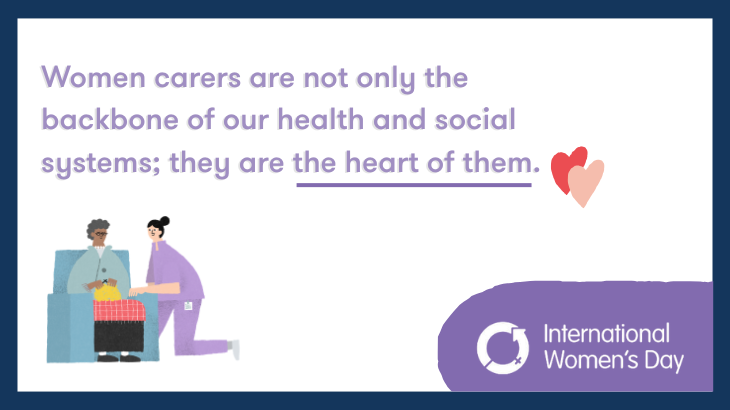
Women carers are not only the backbone of our health and social systems; they are the heart of them.
Useful Resources from IHF
Healthcare Supports
Information and Support Line
The Information and Support Line (1800 60 70 66) is a confidential line that provides signposting, practical supports and resources about end-of-life care in Ireland. Access these resources>>
I Work in Healthcare

Resources for thise working in end of life care, including access to our Caru programme, helpful toolkits, adcanved care planning for professionals, and more. Access these resources>>
I Care for Someone

Useful resources for carers including palliative care resources, self-care tips and information on advanced care planning. Access these resources>>
I am Seriously Ill

When you’re living with an illness that’s no longer curable, it can be difficult to know where or who to turn to. But, support is available. Find information about palliative care, financial support available and planning ahead. Access these resources>>
Dying Well at Home

IHF’s Dying Well at Home programme aims to support end-of-life care at home for people who wish to die at home and those who care for them. On this page, you’ll find information and resources about dying well at home. Access these resources>>
Bereavement Supports
Bereavement Support Line

Our Bereavement Support Line, in partnership with the HSE, is there to provide connection, comfort and support. It is a shoulder for you to lean on. This is a national freephone service 1800 80 70 77 available from 10am to 1pm, Monday to Friday.
I am Bereaved

How we react to loss will be different for everyone. Whether you’re newly bereaved or bereaved many years, grief is a process and it takes time. There is no right or wrong way to grieve. I am Bereaved includes lots of helpful resources for you and your loved ones.
About International Women’s Day
International Women’s Day (IWD), celebrated annually on March 8, is a global day celebrating the social, economic, cultural, and political achievements of women. The day also marks a call to action for advancing gender equality. Marked by millions of people on March 8, IWD provides an important platform to engage with communities, reflect on progress, and commit to positive action. Participation in IWD ensures progress toward equality remains on the global agenda and positive action prevails.
Further Reading
- Women in the Labour Market 2023-2024, Central Statistics Office
- Gender Dimensions of Care – An Irish Perspective, Family Carers Ireland
- A woman’s world?: Palliative care from a gendered perspective, Palliverse
- A Feminist Vision of Care and Economic Equality, National Women’s Council and Action Aid


